Memuat
Memuat
Software

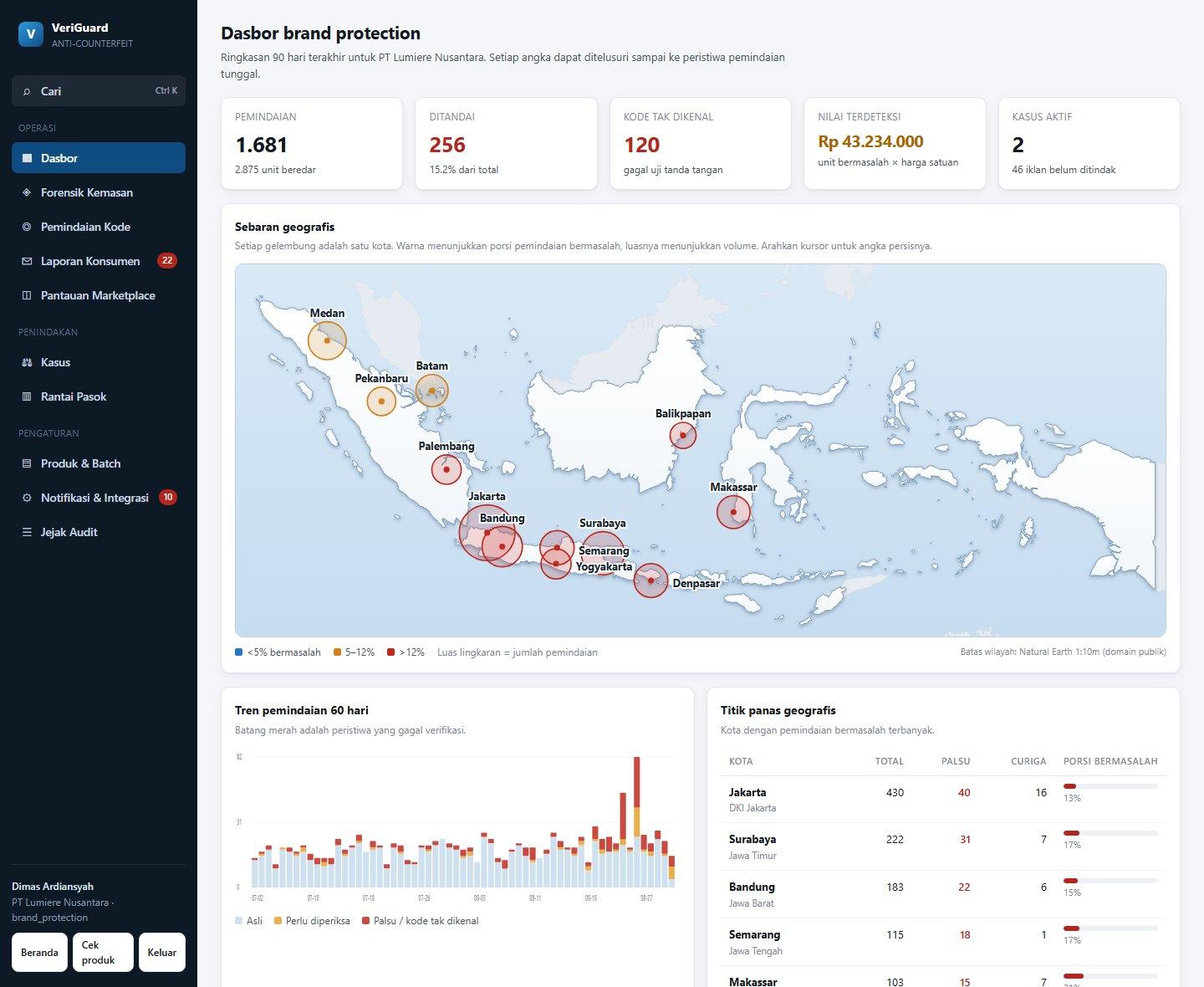
A single serial code cannot be in Jakarta and Medan within thirty minutes. Packaging colors do not drift by a Delta E of 12 coming off the same printing press. Units do not show up in the market before their carton has left the warehouse. VeriGuard turns anomalies like these into a prioritized work queue — and evidence files you can hand to investigators.
Built for brand protection and legal teams at FMCG, cosmetics, and pharmaceutical companies that are losing revenue to counterfeits but have no systematic way to find where those goods are circulating and who is selling them.
Independent signals matter: a counterfeiter may defeat one of them, but cannot defeat them all at once without creating a new pattern that is even easier to spot.
1. Cryptographic serials. Every unit receives a random 40-bit serial signed with HMAC-SHA256. Fabricated codes are rejected without touching the database — counterfeiters printing random labels fail in the first second, and the system cannot be mapped through guessing attacks. Tested with 20,000 random guesses: zero got through.
2. Scan pattern analytics. A single scan proves nothing; the pattern does. Nine weighted rules catch impossible travel, scan floods, codes circulating before their production date, and even export batches leaking into the domestic market. Every rule returns a weight and a plain-language explanation.
3. Packaging image forensics. Seven measurable metrics compare a photo of the unit against factory samples: CIE76 Delta E, DCT perceptual hash, Lab color distribution, print raster signature, fine detail retention, dimensional proportions, and relative sharpness. The output is not a single number but a score, a confidence level, each signal's contribution, and a heat map you can show directly to clients.
4. Security zones. A hologram covering 4% of the packaging surface can disappear entirely without shifting the average Delta E by more than one point — because the remaining 96% stays identical. Brands mark their own critical areas with a drag-a-box editor, and those areas are scored separately.
5. Supply chain aggregation. Unit → carton → pallet. Warehouses scan one carton label, not a hundred unit labels. And a unit that appears in the market when its carton was never shipped is no longer a suspicion — it is channel leakage, a different class of finding from counterfeiting: the goods are genuine, but the route is unrecorded.
1–3 of 12
6. Consumer reports. Detection tells you that counterfeits exist. Consumer reports tell you where they were bought — and that is the only path to the seller, and from there to the supplier. The output is a ranking of the most frequently reported sellers, complete with the number of unique serials per seller.
Every case can be exported as a PDF containing server-timestamped scan events, comparison photos with their difference maps, the chain of custody for physical samples, and an appendix describing the methods and their limitations. The chain of custody is append-only and rejects entries that break the sequence — a chain that can be edited after the fact is worthless as evidence.
Scoped API keys for packaging lines and ERP (no plant operator wants to issue 200,000 serials through browser clicks), GS1 DataMatrix support for brands already using it, sign-in through corporate identity providers (OIDC + PKCE: Azure AD, Google Workspace, Okta), notifications to Slack or Microsoft Teams via webhook, and HMAC key rotation without invalidating serials that are already printed.
The consumer verification page can be installed as an app on a phone and keeps recording codes when there is no signal, then sends them automatically once the network is back.
This section is on the product page on purpose, not in a footnote.
The demo runs with your own products, at your office, with no internet connection. Bring two units: one confirmed genuine from your warehouse, and one suspected counterfeit from the market. If the system finds nothing, that is useful information too.